Tuesday, February 24, 2009

The Sun is Crooked in the Sky; My Father is Thrown Over my Shoulders

I haven't been out to see live performance art in town...

But the posting on moodle was an interesting one. Naufus Ramirez Figueroa sits on the floor amid a mess of powdered milk and ash, wearing only a white t-shirt and underwear. He proceeds to cover his legs with the dusty mixture before turning over onto his belly. He spends the rest of this 100 hour performance in this position, breathing heavily, blowing the powder and ash into a dusty cloud with each breath.

In his statement, he claims to be commenting on race mixing in Latin America, what is known as Mestizaje (the offspring of a Spaniard and an American Indian). Being Mestizo himself, he "analyses inter-family relationships", and "re-discovers the violence that is unavoidable in the history of the Mestizaje".

Although I truly liked the piece, I don't understand how all that is apparent in the work. I see the ash and powdered milk as symbols of race, their particles intermingling with each new breath, each inhale and exhale representing birth and death. But the powdered milk, to me, is more evocative of whiteness than the Latin or American Indian.

On a side note, I would really like to know how it is physically possible to stay awake for 100 hours without the aid of methamphetamines. 

Naufus Ramirez Figueroa

Thursday, February 19, 2009

Winteruption

There was an interesting performance on Granville Island tonight. Underneath Granville Bridge, suspended 20+ feet in the air was a metal platform on which two female dancers suspended by bungee cords were doing some kind of interpretive dance. It looked like a mix between modern and jazz, but I'm no expert. The bungee cords allowed the dancers to float mid-air. Their movements resembled that of ghostly spirits. On the ground below, a cellist was playing music, when I started noticing layers developing. I began looking for other musicians that might be hiding in the darkness, but soon realized the multiple layers were being produced by an electronic loop machine.

A fourth performer appeared, with a flaming hula hoop, and started dancing about. Then two male figures appeared whom I thought were confused spectators. One started singing while the other clung to the bridge support and started moving about suspiciously.

Above, the dancers unleashed two long banners of blue, and incorporated them into their dance.

It all ended when the singing man emerged out of the darkness with a flaming umbrella frame.

The unconventional location made for an interesting performance. There were some elements I liked, such as the suspicious man, where the dancers were situated, and the loop machine. But mostly it was too circus-like for me.

Saturday, February 14, 2009

Shadow Puppet Performance Individual

The entire class was seated, dispersed throughout a room with a projection of a city alleyway on one wall of the room. The lights went out and we were enveloped in darkness save for the projection, on which a silhouette of Heather with a chain of cigarettes dangling from her neck could be seen. She then proceeded to approach at random the seated attendees one by one with the simple word, "Hi". 

This for me was a strong piece. It expresses the sincere desire for intimacy and connection amid a sea of anonymous strangers.

Shadow Puppet Performance group 2

The scene begins with an innocent young girl in the midst of a wheat field as she blows a wheat husk in the wind. Suddenly she finds herself caught in a whirlwind of a magnetic disturbance which transports her into another dimension. Worlds collide and planets revolve before a Peeping Tom gets booted in the face by an oversized foot for spying on the young girl taking off her bra. The strength of this piece lay in how transitions were used to unite by separating disparate elements. It told a narrative story that had a dramatic arc through the journey and adventures of the girl.

Shadow Puppet Performance group 3

As tribal drumming played incessantly, an amorphous form began to unfold and take the shape of a pig's head. A body resembling a police officer entered the scene amid drumming, chanting and yelling noises, and starting interacting slowly with gestures and movements. The strength of this piece was in the hypnotic, entrancing effect of the music, and the slow spare movements of the performers, which captivated the audience using drama instead of overwhelming them with flashy tricks. The symbolism was also intriguing.

Wednesday, February 11, 2009

Relational Art

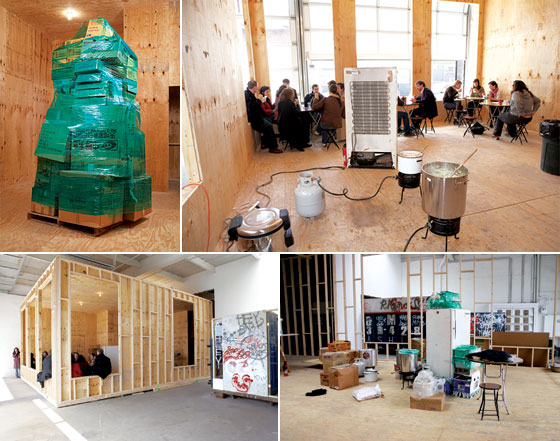
Rirkrit Tiravanija's art belongs to a new artistic movement, Relational Aesthetics, which takes as its theoretical core, the entire scope of human relations and their social context. This runs counter to the prevailing ideology of art as cultural object/commodity in private space. Tiravanija's performances/installations take the form of rooms and stage setups in which gallery goers are welcome to sit and interact with each other while he cooks food, plays music, or reads stories for them. The gallery space functions as architecture for living and socializing rather than as an ominous sanctuary for quiet, private contemplation.

Relational Aesthetics emerges at a time when human interaction is becoming increasingly digitized and depersonalized, stripped of any organic element. 

Although I understand why this movement came about, I don't understand what is artistic about it. What is the difference between this and going to a restaurant or a friend's for dinner, other than the fact that it takes place in an art gallery? If Relational Aesthetics takes the entire range of human interaction as its subject matter, why not look to theatre, or cinema instead?


Tuesday, February 10, 2009

Durational Performance


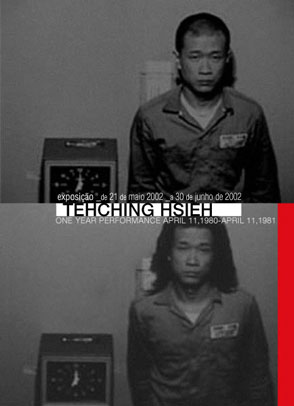
Teching Hsieh is an artist whose works consist of durational performances, each of which involve a particular vow, personal restriction, or other such constraint. His One Year Performances occurred between 1978 and 1986, and his thirteen year performance lasted from 1986 to 1999.  

His artist statement for his thirteen year performance reads:

STATEMENT

I, Teching Hsieh, have a thirteen year's plan
I will make ART during this time.
I will not show it publicly.
This plan will begin on my 36th birthday December 31, 1986
continue until my 49th birthday December 31, 1999.

Teching Hsieh

A One Year Performance in which he ties himself to a partner with a rope reads:

STATEMENT

We, Linda Montana and Teching Hsieh, plan to do a one year performance.
We will stay together and never be alone.
We will be in the same room at the same time, when we are inside.
We will be tied together at waist with an 8 foot rope.
We will never touch each other during the year.
The performance will begin on July 4, 1983 at 6 p.m.
and continue until July 4, 1984 at 6 p.m.

Linda Montano
Teching Hsieh

His works exist counter to an increasingly fast paced culture that values speed and efficiency, and raises important questions about how we value time, and how we spend our lives.

Although these performances, like the films of Andy Warhol, may be unwatchable, it is the concepts themselves that arouse curiosity and intrigue, and interrupt our concept of life.

Community Based Artwork


Rebecca Belmore’s work spans a multitude of media, including photography, installation, video, and performance, which make sharp and poignant commentary on racial stereotypes, gender, and politics of identity. Often Belmore depicts herself bound in awkward, uncomfortable positions as if being held captive by an invisible tormentor. Or slashed viciously across the back. These and other provocative images elicit a strange sense of ambiguity in the viewer leaving him/her unsure about the attacker or oppressor, but with an obvious sense of repression and victim hood.

The Belmore exhibit at the VAG this past summer coincided with the recent apology by the Canadian government for abusive treatment of aboriginal peoples in residential schools. A possible financial compensation of more than $2 billion offered to approximately 80, 000 residential school survivors is also being reviewed. Historically, children were taken away from their families and placed in church and government run schools, where they faced physical, sexual and mental abuses. The children were punished if they spoke their own language, publicly flogged and made to feel ashamed of their own heritage. This caused scars of an emotional type, wounding the pride of an entire people, burdening them with self-hatred and loathing, leading to a plague of various self-destructive behaviors including drug abuse, alcohol abuse, gambling and domestic violence. Belmore’s works speak directly to the issues surrounding bondage, bodily violence, and social marginalization. The Rebecca Belmore exhibit comments on larger national concerns, and invokes in the viewer a sense of sympathy for the First Nations peoples, and brings to the general public a recognition of historical injustice.

Ironically, the institutions which lend her support and give her a platform on which to voice her grievances are the very institutions which have victimized the community for whom she speaks. This puts her in a paradoxical position of either biting the hand that feeds her, or selling out, or both.

http://www.rebeccabelmore.com/home.html

Sunday, February 8, 2009