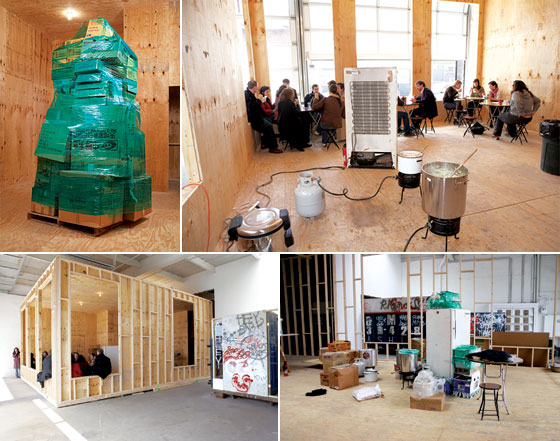
 Rirkrit Tiravanija's art belongs to a new artistic movement, Relational Aesthetics, which takes as its theoretical core, the entire scope of human relations and their social context. This runs counter to the prevailing ideology of art as cultural object/commodity in private space. Tiravanija's performances/installations take the form of rooms and stage setups in which gallery goers are welcome to sit and interact with each other while he cooks food, plays music, or reads stories for them. The gallery space functions as architecture for living and socializing rather than as an ominous sanctuary for quiet, private contemplation.
Relational Aesthetics emerges at a time when human interaction is becoming increasingly digitized and depersonalized, stripped of any organic element.
Although I understand why this movement came about, I don't understand what is artistic about it. What is the difference between this and going to a restaurant or a friend's for dinner, other than the fact that it takes place in an art gallery? If Relational Aesthetics takes the entire range of human interaction as its subject matter, why not look to theatre, or cinema instead?

Of course, one enters the theatre or cinema as a passive observer rather than an active participant. This for me is Relational Aesthetics' only redeeming quality.
ReplyDeleteFrom its name, one would expect that the main aim of Relational Aesthetics is to aestheticize our relationships, or how we relate. As far as I know, this is not being done. Relational Aesthetics, in the true sense of the term would depict the relationship between aesthetes; an aesthetic relationship.
ReplyDelete